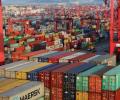
Civil Aviation Minister K Rammohan Naidu announced significant opportunities for Micro, Small, and Medium Enterprises (MSMEs) within India's rapidly expanding aviation sector. With Indian airlines ordering over 1,600 aircraft and the aerospace market projected to double by 2035, there's a massive scope for Indian suppliers to integrate into global aerospace supply chains, moving beyond assembly to design and manufacturing.

Civil Aviation Minister K Ram Mohan Naidu highlights challenges in aircraft procurement due to global supply chain disruptions, impacting India's aviation sector growth and expansion plans.

Civil Aviation Minister K Rammohan Naidu announced India's ambition to produce its first indigenous civilian aircraft within two years through a joint venture. He highlighted the rapid growth of the country's aviation sector, with significant aircraft orders, planned new airports, and potential for manufacturing jet engines and Sustainable Aviation Fuel, underscoring India's increasing role in global aviation.
French aerospace and defence major Thales views India as a highly dynamic market for avionics, with significant growth potential as Indian airlines expand their fleets. The company, which has a substantial presence and MRO facilities in India, is also exploring opportunities to replicate India-developed solutions globally and sees increased use of AI in development.
The year gone by has also forced all airlines to turn the lens sharply on their own costs, workings and internal dynamics, opening their eyes to their vulnerabilities. Fewer, leaner, nimbler players will emerge from the carnage.
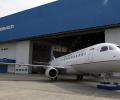
Brazilian aerospace company Embraer has secured type certification from India's aviation regulator, DGCA, for three of its commercial jets (E195-E2, E190, and E195). This approval, alongside an existing certification for its E175 jet, paves the way for Embraer to expand its presence in India's regional aviation market, supported by a strategic MoU with Adani Defence & Aerospace for a Final Assembly Line in Dholera, Gujarat.

The trails of mega-mergers, tailwinds of expanding fleets, flights and airports will dot the fast-growing Indian aviation firmament in 2025, though the dark clouds of supply chain woes will persist longer. Also, new airline takeoffs, the future trajectory of revised norms to tackle pilot fatigue and efforts to reduce carbon emissions will be on the radar.
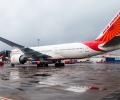
Indian carriers have cancelled over 10,000 flights since the onset of the West Asia conflict, as escalating tensions and airspace restrictions disrupted international operations, a senior government official said.

Indian benchmark indices Sensex and Nifty closed higher for the second consecutive day, primarily driven by robust buying in IT stocks following strong quarterly results and positive global trends. Tech Mahindra notably surged over 8% after reporting a significant jump in net profit.
Civil Aviation Minister K Rammohan Naidu announced India's ambitious plans to become a global hub for civil aviation manufacturing, aiming to produce made-in-India civilian aircraft within two years. He highlighted the expansion of airport capacity to 800 million by 2029, the construction of 100 new airports and 200 heliports, and the success of the UDAN scheme in boosting regional air connectivity and first-time flyers. The minister also noted the growing ecosystem for aviation component manufacturing and partnerships with international players like Embraer and Adani Group.

Aviation security watchdog BCAS is conducting trials of full body scanners at Bengaluru and Cochin airports. The trials aim to collect data to refine algorithms, addressing privacy concerns and ensuring the technology is suitable for Indian passengers before wider deployment across airports.
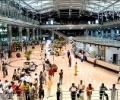
The United States will partner with public and private sectors to support and modernise the Indian aviation sector, American Ambassador to the country Timothy J Roemer said.

The government has introduced new aviation rules, the Bharatiya Vayuyan Niyam, 2026, granting it the power to intervene in airline ticket pricing during extraordinary situations.

Indian equity benchmark indices Sensex and Nifty rallied for the second consecutive session, driven by strong buying in IT firms and a significant boost from Tata Group's retail arm Trent following its impressive September quarter earnings.

Indian benchmark indices, Sensex and Nifty, experienced declines in early trade due to persistently high crude oil prices and significant selling pressure in IT stocks, with global factors like US bond yields and upcoming Federal Reserve decisions also contributing to cautious investor sentiment. Track Sensex, Nifty on October 27.
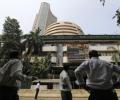
Analysts predict that the US midterm election results, which saw Democrats gain control of Congress, will primarily influence Indian markets through changes in global financial conditions, trade policy expectations, and geopolitical developments, with a keen focus on the US administration's actions in West Asia and their potential impact on crude oil prices.

Indian stock market benchmark indices Sensex and Nifty rallied significantly in early trade, driven by robust foreign fund inflows, better-than-expected Q2 results, and a sustained moderation in crude oil prices. The 30-share BSE Sensex jumped 1,097.33 points, while the 50-share NSE Nifty rallied 274.30 points. Track Sensex, Nifty on November 11.

Indian benchmark equity indices snapped a two-day rally, with the Sensex falling over 500 points and the Nifty settling below 25,230, driven by profit-taking and global market bearishness fueled by US Federal Reserve rate hike speculations.

An Indian national was killed and two others were injured in an attack on King Fahd International Airport in Dammam, Saudi Arabia. This incident follows another attack on the Shaybah oilfield where an Indian was also injured, amidst escalating strikes by Yemen's Houthi rebels on Saudi infrastructure.

GMR Aero Technic is investing Rs 600 crore to expand its Maintenance, Repair and Overhaul (MRO) facility in Hyderabad. The expansion aims to nearly double its capacity to around 18 lines by 2029, including for wide-body aircraft, and will introduce India's first wide-body aircraft painting service, addressing the growing demand from Indian airlines.

Indian stock markets witnessed a strong rebound, with the Sensex climbing nearly 1,000 points to 83,021.75 and the Nifty settling above 25,500 for the first time in nine months, driven by a rally in auto, bank, and FMCG stocks, sustained foreign fund inflows, and easing commodity prices.
Indian stock market benchmark indices Sensex and Nifty closed higher for the second consecutive day, driven by robust foreign fund inflows, better-than-expected Q2 corporate earnings, and a sustained moderation in crude oil prices.

HAL has handed over a new batch of indigenous aircraft, marking another step in India's domestic aerospace manufacturing programme. The company delivered two LCA Tejas FOC twin-seater trainers to the IAF, completing twin-seater deliveries under the FOC contract.

The Federation of Indian Pilots has requested the DGCA to increase random drug testing for pilots, aiming to enhance aviation safety.

Indian benchmark indices Sensex and Nifty rebounded in early trade after two days of losses, driven by easing crude oil prices and strong buying in blue-chip IT stocks, despite continued global uncertainties. Track Sensex, Nifty on September 30.

A potential US-Iran peace deal, expected to be signed on June 19, is anticipated to ease geopolitical stress and benefit various sectors, particularly in India, with analysts suggesting investors await finer details before making significant moves.
Indian benchmark indices Sensex and Nifty extended their rally in early trade, driven by strong buying in IT firms and an earnings-driven surge in Tata Group's retail arm, Trent, which reported a 25 per cent increase in net profit.

Indian IT stocks have experienced their most significant weekly surge in 18 years, with the Nifty IT index climbing 11.72 per cent, as a global sell-off in AI-linked equities redirected investor attention towards India's IT services sector. This shift aligns with a JP Morgan report identifying India as a 'natural AI hedge' due to its large, liquid market and strong domestic institutional investor base.

State-run defence major Hindustan Aeronautics Limited (HAL) has delivered LCA Tejas Final Operational Clearance twin-seater trainers and HTT-40 basic trainer aircraft to the Indian Air Force, along with Dhruv next-generation helicopters to Pawan Hans. This significant handover, witnessed by Defence Minister Rajnath Singh, marks a crucial step in India's journey towards self-reliance in the aerospace sector, showcasing HAL's diverse capabilities in military, civil, and training aviation.
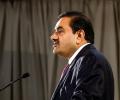
Adani Airport Holdings (AAHL) has announced it will raise 9,825 crore through a primary equity infusion from a consortium of global investors, including Alpha Wave Global, Premji Invest, Temasek, and funds managed by BlackRock, who will collectively acquire a 5.54 per cent stake.

Indian benchmark stock indices, Sensex and Nifty, closed lower due to profit-taking, a spike in wholesale price-based inflation, and firm crude oil prices, despite some support from easing intraday crude oil prices and rupee appreciation.

Researchers at the Indian Institute of Technology Madras (IIT,M) have developed a novel "morphing skin" concept for aircraft wings, inspired by bird flight. This adaptive external skin dynamically reshapes in real time to prevent aerodynamic stalls, enhance lift, reduce drag, and significantly improve aircraft safety and fuel efficiency. The technology holds promise for commercial aviation, unmanned aerial vehicles, and defence applications.
Noting that Indian civil aviation sector is experiencing high levels of growth, Civil Aviation Minister Praful Patel has said the industry must tackle the shortcomings of inadequate infrastructure and shortage of skilled manpower to sustain growth.
Indian benchmark stock indices, Sensex and Nifty, rebounded significantly after a four-day losing streak, driven by value buying and strong performance in metal, telecommunication, and healthcare sectors.

A privately run helicopter carrying five pilgrims from Badrinath and its pilot crashed into a hillside in Joshimath, Uttarakhand, killing all six on board. The Aircraft Accident Investigation Bureau (AAIB) has launched a probe into the incident.

Indian carriers are expected to double their fleet size by 2020 to 1,000 aircraft by 2020, promising a huge opportunity for the maintenance, repair and overhaul business.
